
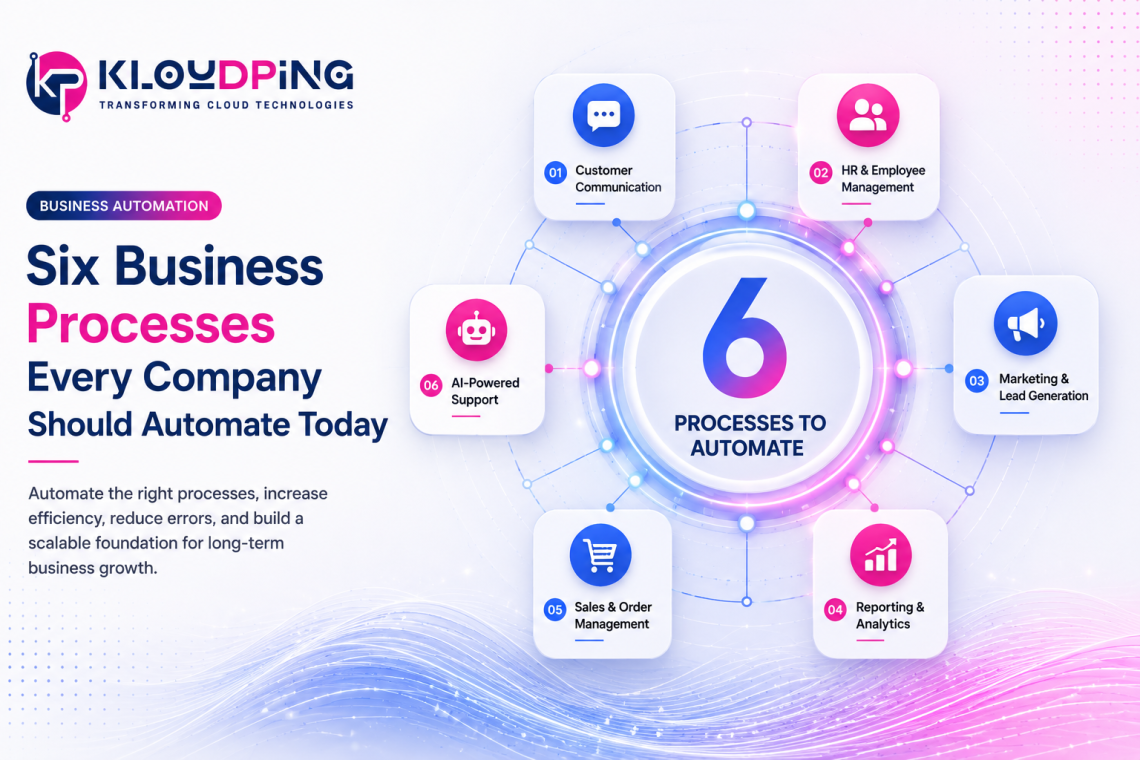
You don’t need to automate everything at once. Start with the six processes that quietly consume the most time in almost every business.
Introduction
Businesses today operate in an environment where speed, efficiency, and customer expectations continue to evolve. Organizations that rely heavily on manual processes often struggle with delayed decision-making, repetitive administrative work, fragmented information, and unnecessary operational costs.
Digital transformation is no longer reserved for large enterprises. Businesses of every size are embracing automation to simplify everyday operations, improve employee productivity, and create better customer experiences.
However, many business leaders still wonder where to begin. The answer is simple: start with the processes that consume the most time, involve repetitive tasks, or require constant coordination between teams.
Automating these critical workflows allows organizations to improve accuracy, reduce manual effort, and create a scalable foundation for future growth. In this article, we explore six essential business processes that every organization should consider automating.
1. Customer Communication
Customer communication is often the first interaction people have with your business. Whether they are requesting information, asking for support, or exploring your products and services, they expect timely and accurate responses.
Manual communication can quickly become overwhelming as customer enquiries increase. Automation helps businesses:
- Respond instantly to enquiries.
- Route conversations to the appropriate department.
- Capture customer information automatically.
- Schedule meetings and appointments.
- Send order confirmations and notifications.
- Follow up with potential customers.
By automating routine interactions, businesses can provide faster service while allowing customer support teams to focus on more complex requests.
2. Human Resource Management
Human Resources departments manage numerous administrative responsibilities every day. Employee onboarding, attendance tracking, leave approvals, payroll coordination, document management, and performance evaluations all require significant time and attention.
Automation simplifies HR operations by creating standardized workflows that improve efficiency and reduce paperwork. Typical HR automation includes:
- Employee self-service portals.
- Digital attendance management.
- Leave application and approval workflows.
- Payroll processing support.
- Employee document management.
- Recruitment and interview scheduling.
- Performance tracking.
When administrative work is automated, HR professionals can dedicate more time to employee engagement and organizational development.
3. Marketing & Social Media Management
Maintaining a consistent digital presence requires careful planning and execution. Marketing teams often manage multiple social media platforms, schedule content, monitor engagement, analyze campaign performance, and respond to customer interactions.
Without automation, these tasks become repetitive and time-consuming. Modern marketing platforms enable organizations to:
- Schedule posts in advance.
- Publish across multiple platforms simultaneously.
- Generate AI-assisted content.
- Monitor engagement metrics.
- Analyze campaign performance.
- Manage content calendars.
Automation ensures consistency while improving overall marketing productivity.
4. Internal Workflow & Approval Management
Many organizations still rely on email chains, spreadsheets, or paper-based approvals for routine business processes. This often results in delays, missed approvals, and poor visibility.
Workflow automation allows businesses to create structured approval processes for activities such as:
- Purchase requests.
- Leave approvals.
- Expense claims.
- Vendor onboarding.
- Project approvals.
- Internal service requests.
Automated workflows ensure that every request follows a defined process while providing transparency and accountability throughout the organization.
5. Reporting & Business Analytics
Decision-making depends on accurate and timely information. Unfortunately, many organizations still spend hours collecting data from multiple systems before creating reports.
Automation enables businesses to generate dashboards and reports in real time. Benefits include:
- Faster reporting.
- Improved data accuracy.
- Better performance monitoring.
- Real-time business insights.
- Reduced manual spreadsheet work.
- Data-driven decision making.
Executives can focus on interpreting insights rather than gathering information.
6. Customer Support & AI Assistance
Customer support has evolved significantly with the introduction of Artificial Intelligence. AI-powered assistants can now handle many routine customer interactions without human intervention.
Common use cases include:
- Frequently asked questions.
- Appointment scheduling.
- Product recommendations.
- Lead qualification.
- Order status updates.
- Technical support.
- Voice-based customer service.
Rather than replacing support teams, AI enhances their capabilities by managing repetitive enquiries while escalating complex issues to human representatives.
Why Businesses Should Start Small
One common misconception about automation is that organizations need to automate everything at once. In reality, successful digital transformation happens gradually.
Businesses often begin with one department or one process before expanding automation across the organization. For example:
- Start with customer communication.
- Introduce HR automation.
- Add marketing automation.
- Implement workflow approvals.
- Expand reporting capabilities.
- Introduce AI-powered customer engagement.
This phased approach minimizes disruption while delivering measurable improvements over time.
Building a Connected Business Ecosystem
Automation delivers even greater value when multiple business functions work together. Imagine this scenario: a customer submits an enquiry through WhatsApp, and the system automatically:
- Captures customer information.
- Creates a sales lead.
- Schedules a product demonstration.
- Notifies the sales representative.
- Records communication history.
- Generates follow-up reminders.
- Updates management dashboards.
Instead of separate applications performing isolated tasks, everything works together within one connected ecosystem. This is the future of business operations.
How UBAS Helps Businesses Automate
UBAS (Unified Business Automation Suite) is designed to simplify business operations by bringing multiple software solutions together on one intelligent platform.
Rather than purchasing and managing separate applications, organizations can automate multiple business functions through a single integrated ecosystem. The UBAS platform includes:
WAZONE
AI-powered WhatsApp Business Automation for customer engagement, marketing campaigns, lead management, and support.
Elastic
A centralized social media management platform for content creation, publishing, scheduling, analytics, and performance monitoring.
HRMS
A complete workforce management solution covering employee records, attendance, leave management, payroll support, recruitment, and performance tracking.
School Management System
A digital platform that streamlines admissions, attendance, academic management, examinations, fee collection, communication, and parent engagement.
SEO Suite
An intelligent optimization platform providing website audits, keyword tracking, competitor analysis, technical SEO insights, and performance reporting.
AI Voice Agent
An AI-powered virtual assistant capable of answering calls, qualifying leads, scheduling appointments, and providing 24/7 customer support.
Together, these solutions enable businesses to automate operations while maintaining a consistent user experience across departments.
The Road Ahead
Automation is becoming an essential component of modern business strategy. Organizations that embrace intelligent technologies today will be better equipped to adapt to changing customer expectations, market conditions, and operational demands.
As artificial intelligence, cloud computing, and automation continue to evolve, businesses that invest in connected digital ecosystems will gain a significant competitive advantage.
The goal is not simply to automate tasks — it is to create smarter organizations where people and technology work together seamlessly.
Conclusion
Every business has processes that consume unnecessary time and resources. By identifying repetitive workflows and introducing automation strategically, organizations can improve productivity, reduce costs, and enhance customer experiences.
Starting with key areas such as customer communication, HR, marketing, approvals, reporting, and AI-powered support provides a strong foundation for long-term digital transformation.
With a unified platform like UBAS, businesses can move beyond disconnected tools and build a connected ecosystem that grows alongside their ambitions.
Key Takeaways
- Automate repetitive tasks to improve productivity and reduce operational costs.
- Begin with high-impact processes such as communication, HR, and marketing.
- Use workflow automation to improve transparency and accountability.
- Leverage AI to enhance — not replace — customer support.
- Adopt an integrated platform that scales with your business.
Ready to Automate Your First Process?
Discover how the UBAS Platform can help you automate customer communication, HR, marketing, approvals, and reporting from one connected ecosystem.
About the Author
UBAS Editorial Team
The UBAS Editorial Team is dedicated to sharing expert insights on business automation, AI, cloud technologies, workforce management, digital marketing, and enterprise software. Through practical articles and industry knowledge, we help organizations make informed decisions on their digital transformation journey.
Related Articles
- The Future of Business Automation: Why Every Growing Business Needs an Integrated Platform
- How AI & WhatsApp Automation Are Revolutionizing Customer Communication
- Five Signs Your Business Has Outgrown Manual Processes
- AI Voice Agents: The Future of Customer Service
- Building a Scalable Digital Workplace with Integrated SaaS Solutions