
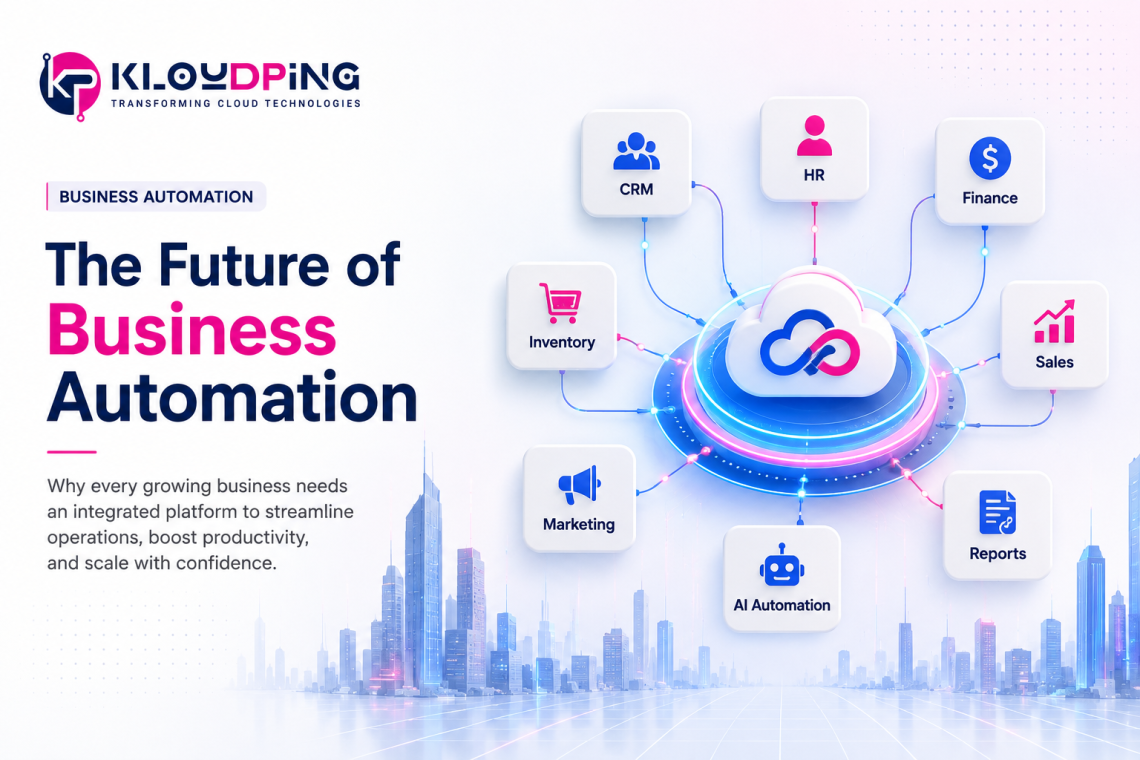
The future of business belongs to organizations that simplify operations — not those that add complexity.
Introduction
The way businesses operate has changed dramatically over the last decade. Organizations are no longer relying solely on manual processes, spreadsheets, or disconnected software applications to manage their operations. Instead, they are embracing digital transformation to improve efficiency, enhance customer experiences, and remain competitive in an increasingly technology-driven marketplace.
Despite this shift, many businesses continue to face a common challenge: software fragmentation.
Customer communication may happen through one platform, employee management through another, social media through a third, and reporting through several more. While each application serves its own purpose, the lack of integration often leads to duplicated work, inconsistent data, slower decision-making, and increased operational costs.
Business automation is changing this landscape by bringing people, processes, and technology together under one connected ecosystem. Instead of spending valuable time switching between multiple applications, organizations can automate repetitive tasks, centralize information, and enable teams to collaborate more effectively.
Why Businesses Are Rethinking Their Technology Stack
As companies grow, their software ecosystem often grows with them. A CRM for sales, HR software for employees, project management tools for operations, marketing platforms for campaigns, and communication tools for customer engagement become everyday necessities.
While these tools solve individual challenges, they rarely operate as one connected system. The result is an environment where information becomes scattered across multiple applications, making it difficult to maintain consistency and gain a complete picture of business performance.
Some of the most common challenges businesses face include:
- Multiple software subscriptions that increase operational costs.
- Duplicate data entry across different systems.
- Manual workflows that consume valuable employee time.
- Delayed reporting due to disconnected information.
- Limited collaboration between departments.
- Inconsistent customer and employee experiences.
As organizations continue to expand, these challenges become even more significant, making integrated technology an essential part of sustainable growth.
What Is Business Automation?
Business automation is the use of technology to streamline repetitive processes, reduce manual intervention, and improve the efficiency of everyday operations.
Rather than replacing people, automation empowers employees by allowing them to focus on strategic, creative, and customer-focused activities while routine tasks are handled automatically.
Automation can be applied across almost every department, including:
- Customer communication
- Marketing
- Human resources
- Finance
- Education administration
- Customer support
- Reporting
- Workflow approvals
- Internal communication
When these automated processes are connected through a single platform, organizations gain better visibility, improved accuracy, and faster decision-making.
The Benefits of a Unified Business Platform
One of the biggest shifts in modern software is the move from isolated applications to integrated platforms. A unified platform connects different business functions through one secure ecosystem, enabling information to flow seamlessly across departments.
This approach offers several advantages.
Centralized Information
Instead of maintaining separate databases for different departments, all relevant information is stored within a connected environment. This improves data accuracy and reduces duplicate entries.
Improved Collaboration
Sales teams, HR professionals, administrators, marketers, and management can work together using shared information rather than isolated systems. This leads to faster communication and better decision-making.
Increased Productivity
Automation reduces repetitive administrative work, allowing employees to spend more time on activities that create value for the organization.
Better Customer Experience
Connected systems allow businesses to respond more quickly, provide personalized interactions, and maintain consistent communication throughout the customer journey.
Scalability
As organizations grow, a unified platform can expand by introducing new modules without requiring businesses to replace existing infrastructure.
Key Areas Where Automation Delivers Results
Customer Communication
Customers expect immediate responses regardless of the time of day. Automation allows businesses to:
- Answer frequently asked questions.
- Route inquiries to the appropriate department.
- Schedule appointments.
- Send reminders and notifications.
- Nurture leads automatically.
This improves response times while ensuring a consistent customer experience.
Marketing Automation
Modern marketing extends far beyond publishing content. Businesses now require tools to:
- Schedule campaigns.
- Manage multiple social media platforms.
- Analyze engagement.
- Measure campaign performance.
- Generate AI-assisted content.
Marketing automation enables teams to execute campaigns more efficiently while gaining valuable performance insights.
Human Resource Management
Human resources departments often spend considerable time on administrative activities such as attendance tracking, leave approvals, employee records, payroll coordination, and performance monitoring.
Automation simplifies these processes, reducing paperwork and improving operational efficiency. Employees also benefit through self-service portals that allow them to access information independently.
Education Management
Educational institutions face unique operational challenges involving admissions, attendance, examinations, fee collection, academic planning, and communication with parents.
Digital platforms help schools centralize these activities while improving transparency for teachers, students, and administrators.
AI-Powered Business Operations
Artificial intelligence is becoming an integral part of modern business. Organizations are increasingly adopting AI to:
- Automate customer support.
- Qualify leads.
- Analyze business data.
- Generate content.
- Improve operational decision-making.
AI enables businesses to deliver faster, more personalized services while reducing manual effort.
Preparing for the Future
Technology continues to evolve rapidly. Businesses that invest in connected digital ecosystems today will be better prepared for tomorrow’s challenges.
Future-ready organizations share several common characteristics:
- They automate repetitive work.
- They centralize information.
- They empower employees with better tools.
- They make decisions using real-time data.
- They prioritize customer experience.
- They remain flexible as business needs evolve.
Business automation provides the foundation required to achieve these objectives.
Why UBAS Represents This Vision
At UBAS, our mission is to simplify business operations through one unified platform. Rather than requiring organizations to manage separate applications for communication, HR, marketing, education, SEO, and AI, UBAS brings these capabilities together within a connected ecosystem.
Our platform includes:
- WAZONE – WhatsApp Business Automation.
- Elastic – AI-powered Social Media Management.
- HRMS – Workforce Management.
- School Management System – Digital Campus Administration.
- SEO Suite – Search Performance & Website Optimization.
- AI Voice Agent – Intelligent Voice Automation.
Each solution is designed to solve a specific business challenge while integrating seamlessly into the larger UBAS platform.
Final Thoughts
Business automation is no longer an optional investment — it has become a strategic requirement for organizations seeking sustainable growth.
Companies that continue relying on disconnected systems will face increasing operational complexity, while those embracing unified platforms will benefit from improved collaboration, greater efficiency, and stronger customer experiences.
The future belongs to businesses that work smarter, automate intelligently, and build technology ecosystems that scale with their ambitions.
Whether you’re taking your first step toward automation or expanding your digital capabilities, adopting an integrated platform can become one of the most valuable decisions your organization makes.
Key Takeaways
- Automation reduces repetitive work and improves productivity.
- Integrated platforms eliminate disconnected software.
- Centralized data leads to better business decisions.
- AI is becoming a core component of modern business operations.
- Digital transformation is essential for long-term business growth.
Ready to Simplify Your Business?
Discover how the UBAS Platform can help you automate operations, improve collaboration, and accelerate business growth.
About the Author
UBAS Editorial Team
The UBAS Editorial Team shares practical insights, industry trends, and technology best practices focused on business automation, artificial intelligence, digital transformation, cloud computing, and productivity solutions. Our goal is to help organizations embrace smarter ways of working through innovative technology.
Related Articles
- How AI & WhatsApp Automation Are Revolutionizing Customer Communication
- Six Business Processes Every Company Should Automate Today
- Choosing the Right HRMS for a Growing Business
- Why Schools Are Moving to Digital Campus Management
- AI Voice Agents: The Next Evolution of Customer Support